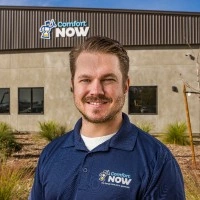
Work directly with Steven Crosby and Dustin Miller to identify lost profitability, correct the operating problems behind it, and build management accountability that lasts beyond the next meeting.
This is home services operating consulting. Not a software subscription. Not a lead package. A clearer path from the business you run to the result you expect.
If your HVAC, plumbing, electrical, or drain company stays busy but produces disappointing earnings, the answer may not be more leads. Missed bookings, wasted paid hours, unattended replacement opportunities, and installation overruns consume the margin you expected.
SOG is an operating partnership led by Steven Crosby and Dustin Miller. We help owners identify where profit is being lost and implement the operating discipline needed to improve it. You work with both partners for judgment and implementation support—not just access to reports.
Call conversion and capacity
Are qualified calls becoming booked jobs? Are cancellations worked? Does dispatch match skills, geography, and available hours to the work? We examine booking rates, schedule utilization, call-center execution, and productive capacity before recommending more demand.
Service quality, sales, and turnovers
Technicians need accurate diagnostics, documented findings, and appropriate options the customer can understand. In HVAC, airflow, static pressure, and system commissioning deserve attention—not assumptions that turn a correctable problem into an unnecessary replacement. Better sales must come from better service and informed customer decisions.
We identify who originated an opportunity, who closed it, and who owns follow-up. A turnover is not a closed sale. A sold estimate is not installed production. Role credit stays distinct without duplicating company revenue.
Installations, purchasing, and job economics
Sold-not-installed work, material readiness, labor hours, purchasing discipline, job costing, startup quality, and callbacks are reviewed together. A large install ticket does not tell you whether the job was profitable. You need the actual direct costs and labor evidence.
Leadership and the daily operating rhythm
Pricing, marketing efficiency, memberships, overhead, and department contribution need ownership. Managers need a useful review rhythm, specific corrective actions, and evidence that the changes were completed—not another explanation at month-end.
Find the operating problem. Assign the owner. Measure the correction.
Steven and Dustin bring different, complementary operating histories. Both understand field service and company leadership. The engagement connects Steven’s executive operating experience with Dustin’s experience founding and building Comfort Now.
Steven Crosby
FIELD SERVICE / EXECUTIVE OPERATIONS
01
Air Pros USA
LARGE-SCALE HOME SERVICES OPERATIONS
Steven’s experience with Air Pros USA developed his understanding of operating complexity within a substantial residential home services organization: sales, customer service, field production, reporting, and leadership across multiple service locations.
02
Service Einstein
HOME SERVICES BUSINESS CONSULTING
Steven worked in a consulting capacity focused on evaluating contractor operations, identifying performance problems, developing management accountability, and implementing operating systems. Translating a diagnosis into execution has been central to his career.
03
Platform Partner Holdings
EXECUTIVE OPERATIONS / MULTI-COMPANY PERFORMANCE
Steven’s executive responsibilities involved an organization of approximately 30–38 companies and more than 1,000 employees, generating approximately $100–$150 million in total annual revenue. Those figures describe the scale of the overall organization—not revenue per location or results he personally generated.
The work included building management teams, establishing organizational structure, implementing sales and service processes, monitoring labor and gross margins, and addressing execution weaknesses across companies and locations.
04
Lickety Split
CHIEF OPERATING OFFICER
As COO of Lickety Split Air Conditioning, Plumbing & Electrical, Steven held direct responsibilities for operational leadership, department management, financial accountability, and organizational execution. Pricing, purchasing, labor, and margin review needed to become corrective action—not just commentary.
Dustin Miller
FOUNDER / CONTRACTOR OWNERSHIP
Dustin founded Comfort Now in Visalia, California, in 2011 after gaining experience in his family’s contracting business. He initially worked alone on service calls and hired his first employee six months later. That history matters when you are trying to move from being the person who solves every problem to leading a team that can deliver consistently.
His background includes a communications degree from Fresno State and an associate degree in Environmental Control Technology. He worked as both a service manager and technician before building Comfort Now. Technical understanding, customer communication, and team leadership have been part of the same operating job.
At Comfort Now, Dustin emphasized hiring for aptitude and attitude, providing technical training, and supporting employees’ development. The company received The ACHR NEWS’ 2019 Best Contractor to Work For recognition in the West region. Those practices bring substance to SOG’s focus on building capable people—not just demanding better numbers.
Dustin’s experience building and leading Comfort Now brings a founder’s perspective to the engagement: service processes, employee development, customer experience, and a business that depends on more than one person.
Dustin’s business background also includes Pest Control Now in Visalia ↗, adding experience in another home-services trade. This complements his HVAC operating background without implying current ownership of Comfort Now.
Dustin is listed as managing member of On The Way Heating & Air in its public BBB business profile. His background and Steven’s operating experience come together in SOG’s consulting engagement, keeping staffing, cash flow, demand, dispatch, and field production close to the work—not just topics in a presentation.
SOG brings both perspectives to independent owners who want stronger operating systems without selling their business or giving up equity.
03 / MEASURE THE ECONOMICS HONESTLY
Stronger profit. Not better-looking adjustments.
We agree on a baseline period, normally a trailing 12 months where reliable records exist. If the company is newer or the records are incomplete, we establish an appropriate alternative and disclose the limitations. Follow-up comparisons use agreed periods and consistent treatment of seasonality, revenue recognition, business scope, and unusual events.
EBITDA means earnings before interest, taxes, depreciation, and amortization. We document any adjustments and apply them consistently. That includes a realistic replacement wage and related employment costs for the owner’s operating role. Your labor is not free because you take distributions.
Consulting costs belong in the economics. Recurring engagement costs remain expenses; they are not added back to manufacture a better result. A genuinely nonrecurring adjustment needs evidence and an agreed rationale.
A ten-point gap is not a small difference.
20–25% EBITDA is the operating standard we work toward in a properly run home-services business. Reaching that level takes disciplined pricing, productive labor, controlled job costs, and managers who own their results. Being busy is not the same as operating well.
Consider a company producing $5 million in annual revenue. At a 10% EBITDA margin, it generates $500,000 in annual EBITDA. At 20%, it generates $1 million. The ten-percentage-point difference is $500,000 a year—not a rounding error, and not a requirement to sell more work.
Same $5 million in revenue. $500,000 more annual EBITDA.
Illustration of a 10% to 20% EBITDA-margin change, not a promised result. Revenue is held constant. Added consulting and implementation costs reduce the net benefit.
The need for control does not depend on company size.
A $2 million a year shop has a $200,000 annual gap in the same ten-point illustration. You do not need a $5 million company to have a six-figure profitability opportunity. And you do not need the same consulting scope as a much larger operator.
At $500,000 in annual revenue, the same ten-point gap is $50,000. At $10 million, it is $1 million. Whether you run one truck or multiple locations, you need to know what your work costs, where margin is lost, and where the cash is.
If you cannot control those fundamentals, you are not ready to scale—no matter how large the company already is. The next step is to build the controls, give your managers clear ownership, and act on reliable numbers. More leads and a fuller schedule will not fix an operation that cannot measure and manage its own performance.
SOG has plans for businesses of different sizes. We match scope, support, and investment to your operating complexity, priorities, and ability to implement. The question is not just what professional support costs—it is what leaving a documented profit gap unresolved may cost your business.
We diagnose the gap, set a credible target, and measure the improvement against an agreed baseline. Results depend on your economics and execution; any performance-linked terms are defined separately in writing.
One operating conversation. Different sources of truth.
Your CRM describes activity. QuickBooks provides accounting records. Bank, merchant, and financing evidence establishes settlement. They are related—but they are not interchangeable.
Completed production is not automatically closed accounting revenue. A recorded CRM payment, posted invoice, or financing approval does not prove cleared cash. Bank cash is not EBITDA: working capital, capital spending, financing, and debt payments can change cash without representing operating earnings.
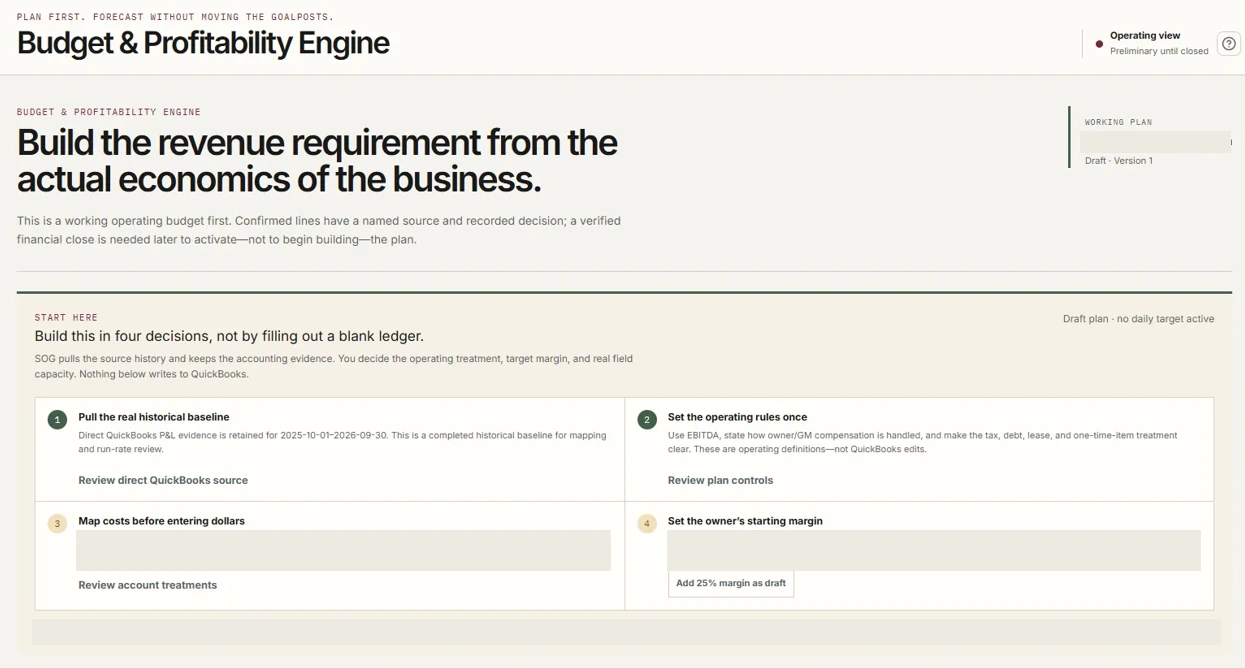
SOG Operating Intelligence is the proprietary infrastructure supporting the engagement. Pulse, LTM, technician and install views, working budgets, finance review, and work queues give management a retained operating record. The point is not another dashboard. It is being able to act on the right number.
SOG / BUDGET & PROFITABILITYACTUAL INTERFACE
View the interface ↗Real application screen. Company-specific details obscured; not a claim of client performance.
Current direct capabilities include read-only ServiceTitan operating imports and QuickBooks financial-report integration. Bank and payroll connections require their own setup and evidence review. We confirm systems and compatibility during scoping; universal integration is not assumed.
Live operating views remain distinct from approved, closed financial actuals. Exceptions need an owner and supporting evidence. Financial-treatment questions go through your designated bookkeeper, accountant, or controller. The platform never writes accounting changes to QuickBooks.
One engagement. A protected operating workspace.Existing SOG clients can sign in to the application. Prospective clients should start with the assessment so fit, scope, systems, and access are agreed first.
Working with Steven and Dustin is central to the engagement. Meeting cadence, communication channels, responsibilities, onsite work where applicable, and implementation involvement are agreed in scope. Direct involvement from both partners does not mean unlimited availability or a substitute for every management position.
Establish the baseline
Review records, reporting definitions, department economics, capacity, and management practices.
Deliverables: assessment summary, documented baseline, and evidence or reconciliation gaps to resolve.
Prioritize the opportunities
Separate material opportunities from distractions. Evaluate likely impact and implementation demands.
Deliverables: ranked improvement roadmap, accountable owners, milestones, and measurement criteria.
Implement the operating processes
Within the agreed scope, establish practical controls for booking, dispatch, service, turnovers, installs, costs, and reporting.
Deliverables may include: department scorecards, handoff checklists, budget assumptions, and corrective action plans.
Build leadership accountability
Define who owns each result, how it is reviewed, and when a missed commitment gets escalated.
Deliverables: management review agendas, coaching, escalation rules, and an action register.
Measure, refine, and sustain
Compare performance against the agreed baseline and plan. Review implementation evidence and adjust priorities as conditions change.
Deliverables: progress reviews, documented variances, and an updated operating plan. Your team remains responsible for execution.
SOG has plans for owner-led shops, growing independent contractors, and established multi-location home services businesses. Scope, support, and investment are matched to the company—not a minimum revenue number or a one-size-fits-all package. An owner must be able to share appropriate records, fund the agreed support, and involve responsible managers.
You do not need perfect reporting to start. You need the willingness to establish reliable numbers and address what they reveal. We assess operational complexity, the credible improvement opportunity, and your capacity to execute before recommending scope.
This is not a fit for guaranteed-return seekers, unsupported accounting adjustments, aggressive replacement selling, or improvement without management involvement. Owners retain decision-making authority and equity. The consultancy provides operating expertise, structure, and accountability—not a transfer of ownership.
07 / CANDID ANSWERS
Before you apply.
Do you guarantee an EBITDA improvement?
No unconditional financial guarantee is offered. Targets depend on qualification, baseline quality, scope, timing, and implementation. Any performance-linked terms would require a separate written agreement defining measurement, costs, obligations, and any remedy.
How do I decide whether the fee makes sense?
Compare the proposed scope and cost with credible improvement opportunities, your ability to implement, and the expected time required. We evaluate the economics including consulting expenses. If the business cannot support the investment, the engagement should not proceed.
Will I actually work with Steven and Dustin?
Yes. The engagement is built around working with both Steven Crosby and Dustin Miller. Review cadence, each partner’s involvement, communication, onsite work where applicable, and implementation responsibilities are agreed before work starts—not unlimited availability.
Why not hire a coach, analyst, or software vendor?
Each can be useful. SOG is for owners who need operating analysis connected to implementation and management accountability. Steven brings field-to-executive operating experience; Dustin brings the experience of founding and building Comfort Now. The shared platform supports their work with your management team.
Do I have to replace my existing systems?
Not automatically. We assess your CRM, accounting system, reporting access, and settlement sources before recommending an approach. Compatibility is confirmed during scoping. Controlled reports may be appropriate where direct connections are unavailable.
What if my books or reporting are unreliable?
That becomes an early priority. We identify gaps and coordinate with your finance team to establish usable evidence. Preliminary operating information can guide questions, but it cannot justify claims about closed profit or cleared cash.
Does this require selling equity or giving up control?
No. The consulting offer does not require a business sale or equity surrender. You retain decision-making authority. What it requires is access, management participation, and willingness to make agreed changes.
START WITH A SERIOUS LOOK AT THE BUSINESS
If the work is there, examine the opportunity.
Let’s determine whether the operating problems are identifiable, correctable, and worth addressing together.